

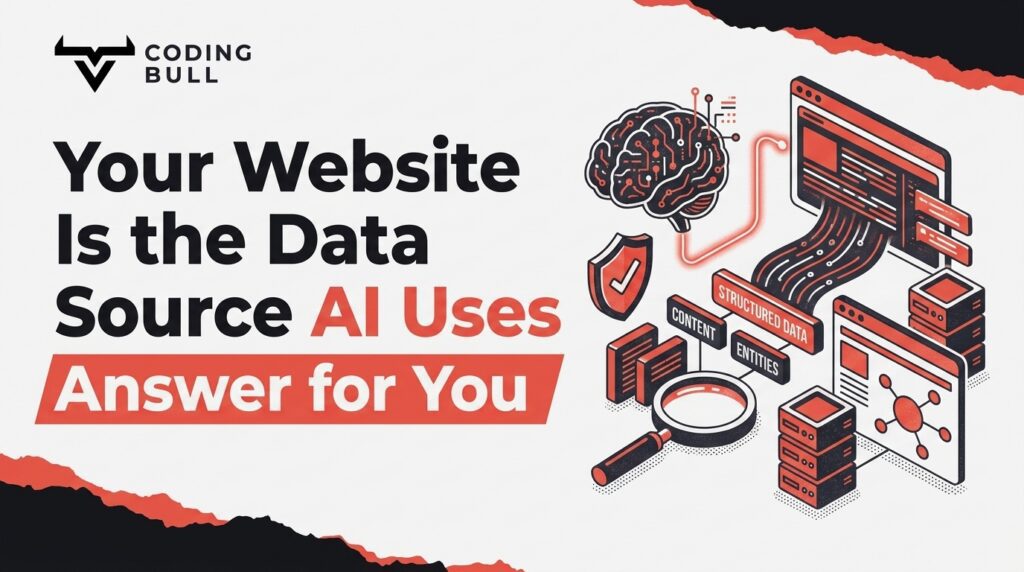
AI has become the new front door to information. People now ask ChatGPT, Gemini, and Perplexity instead of browsing search results directly, and they often trust the AI’s synthesized answer more than a page of blue links. That trust is powerful because the AI presents its reasoning in a detailed, confident way that feels more persuasive than a plain list. When an AI mentions a brand inside an answer, that mention carries a longer-lasting, more positive impression than a single search listing ever could.
The businesses getting mentioned are not random. Your Website Is the Only Place You Control How AI Sees Your Brand. AI systems pull from your own site to decide who you are, what you do, and whether you’re worth citing. If your site is thin, outdated, or hard to parse, the AI either skips you or builds its answer from whatever secondhand mentions it can find. Either way, you lose the ability to shape the narrative. The good news: you can change that by treating your website as the raw data source for AI.
The Shift from Clicks to Citations: How AI is Changing Discovery
Traditional search rewarded clicks. A high-ranking page could expect a steady flow of visitors. AI-generated search has changed that. AI Overviews, ChatGPT, and Perplexity provide complete answers in the chat window. Users get what they need without clicking through to a website. Depending on query type, click-through rates on traditional results are dropping between 15 and 60 percent. For informational queries, the drop is steepest; for transactional queries, some clicks remain, but even those are being reshaped by AI recommendations.
Visibility now happens inside the AI’s answer, not just on a results page. A brand can be mentioned, quoted, or listed as a source without the user ever visiting the site. That means your website’s job is no longer just to attract clicks—it’s to be the source the AI chooses when it builds an answer.

Your Website as the Entity Hub: The Foundation of AI Citations
Crafting a Clear Brand Identity for AI Comprehension
AI models don’t ‘know’ your business unless your website teaches them. Your domain, about page, service descriptions, and consistent name, address, and phone number create an entity. State plainly who you are, who you help, and what changes because of your work. Avoid vague taglines. Use the same business name, logo, and description across every page and every other platform. This consistency is what lets an AI confidently attribute facts to you instead of a generic competitor.
Building Trust Signals AI Recognizes
AI systems look for corroboration. A well-maintained website includes current author names, visible publication dates, a real contact page, a privacy policy, and links to your active social profiles. When an AI sees these signals on your site, it treats you as a verifiable source rather than an anonymous page. The stronger your own trust layer, the more likely the AI is to cite you over a third-party directory or review site.
Using Structured Data to Define Your Entity
Structured data, often called schema markup, gives AI explicit, machine-readable definitions of what your business is. You can mark up your organization type, services, service area, opening hours, and even FAQs. This removes ambiguity. Instead of the AI guessing whether you’re a plumber or a construction firm, your schema says it in a format the model can process directly. Add schema for local business, organization, and FAQ sections to make your site a clean data source.

Trust and Verification: Your Website as the Proof Layer
AI can hallucinate, mix old and new information, or produce confident but wrong answers. Users know this, so after reading an AI response they often click through to the original source to verify. Your website is that proof layer. If the AI quoted you accurately, a visitor who lands on a clear, well-structured site becomes more confident in both the AI and your brand. If the AI got something wrong, your site is the only place where you can correct the record. Without a strong website, you have no way to counter an AI-generated narrative.
A generic answer from AI usually means the model could not find enough trustworthy detail about you. When your site clearly explains your services, limits, and differentiators, the AI’s summary improves—and so does the visitor’s trust after verification.
The One Asset You Fully Control: Your Website Is the Only Place You Control How AI Sees Your Brand
Social platforms, directories, and even AI chat interfaces are rented ground. Their algorithms change, accounts get restricted, and reach can vanish overnight. Your website is the only asset you own outright. You control the layout, the content, the structure, and the updates. When AI models and search systems evolve, your site remains the stable, controllable source of truth about your business.
Every other channel should point back to your website. Social profiles, local listings, ads, and email campaigns all work best when they lead a person or an AI crawler to one authoritative hub. The more consistently you link to your own domain, the more likely AI is to treat it as the definitive source for your entity.
Consolidating Your Online Presence Back to Your Website
Review where your business appears online: social bios, App Store descriptions, partner pages, directory listings. Make sure the business name, address, phone number, and core service descriptions match your website exactly. When an AI encounters the same information in multiple places that all point back to your site, it builds a coherent entity graph with your website at the center. We apply these entity and answer-focused principles to every site we build, and the result is an average lead generation rate of 15.68%—more than three times the industry average of 5%.
What Businesses Need to Do Differently Now: Adapting to AI Search
Answer Real Questions Directly
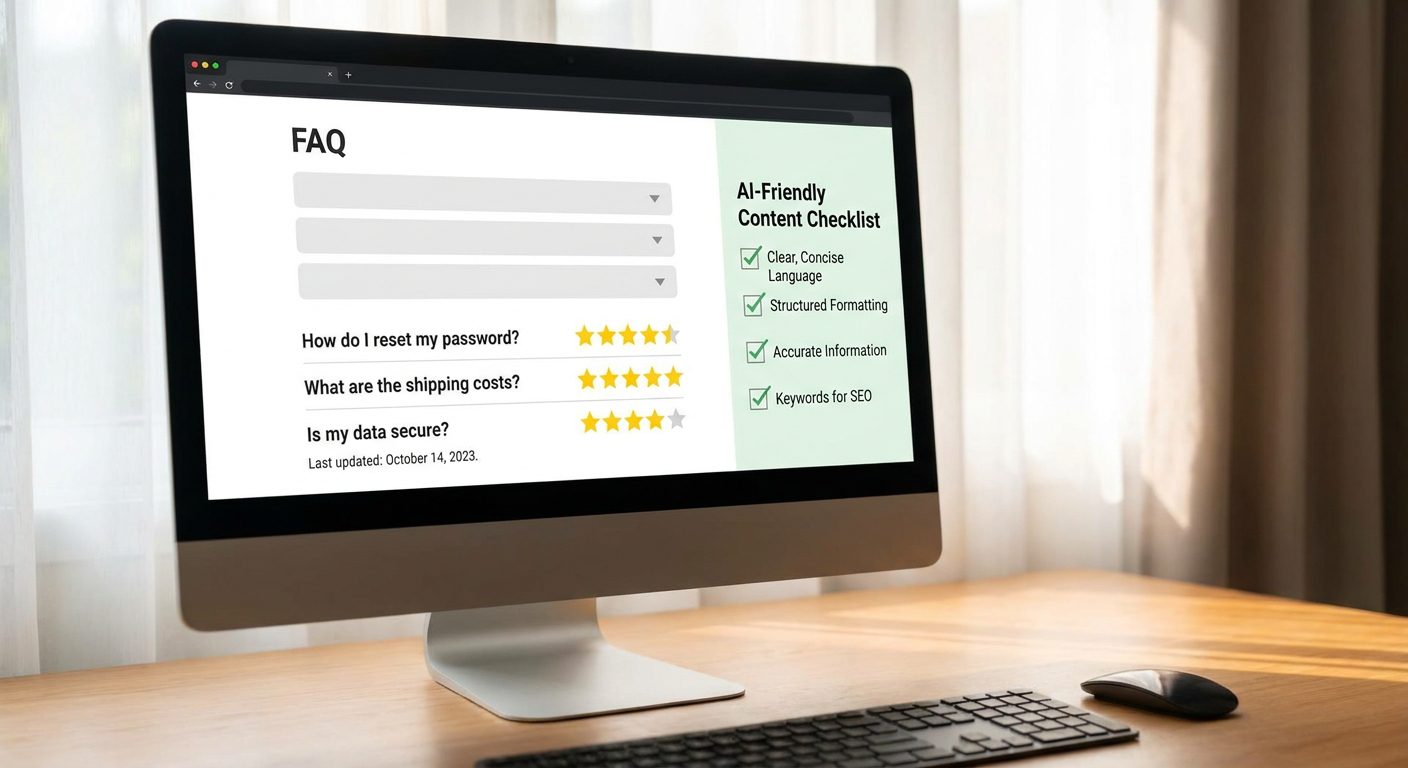
Write content that answers the questions your customers actually type or speak. Start with a clear, concise answer, then add supporting detail. Use FAQ sections for common concerns. Write in plain language. When an AI extracts an answer, it favors content that directly addresses a question without forcing users to dig through fluff.
Prioritize Technical SEO for AI Crawlers
AI crawlers rely on clean, accessible HTML. Use descriptive headings, fast load times, mobile-friendly design, and clear internal links. Add schema markup. Ensure your content is not hidden behind JavaScript that blocks crawlers. A technically sound site is easier for both traditional search engines and AI systems to parse and quote.
Keep Content Fresh and Updated
Outdated information turns your own website into a source of misinformation. Review key pages every quarter: services, team, contact details, and any claims about your business. Show a visible last-updated date where appropriate. When AI detects freshness signals, it is more likely to trust your site as current and relevant.
Avoid Common Mistakes That Confuse AI
- Thin pages with only a few sentences
- Duplicate content across multiple pages
- Vague service descriptions like ‘quality solutions’
- Missing contact information or inconsistent NAP
- Heavy JavaScript that hides content from crawlers
- No schema markup or structured data
Each of these makes it harder for AI to extract a clear answer, so the model skips you and pulls from a competitor or an outdated directory instead.
GEO and AEO in Plain Terms: The New SEO for AI
Generative engine optimization (GEO) and answer engine optimization (AEO) are the modern evolution of SEO. Traditional SEO focused on ranking high on a results page. GEO and AEO focus on being selected, quoted, and trusted by AI systems that generate answers. The goal is not just visibility but citation. You optimize for extraction: clear entities, direct answers, structured data, and trust signals all increase the chance an AI pulls your content into its response.
Think of it as teaching the model to answer with your words. When your website is the clearest, most complete source for a question, the AI’s generated answer will naturally reflect your framing, your terminology, and your recommendations. That is the real prize: your brand becomes the default reference inside the conversation.

Conclusion: Take Control of Your AI Narrative
In the AI era, a strong, well-structured, regularly updated website is not optional. It is the mechanism by which your business gets represented accurately inside AI conversations happening with or without your knowledge. When your site clearly defines who you are, what you do, and why you’re the right choice, you give AI systems a trustworthy source to cite. When you don’t, you surrender that narrative to whoever else the model happens to find.
Start by auditing your own site’s clarity, structure, and trust signals. If you’re not sure where to begin, we can help you identify the gaps that matter most for AI citation.
