

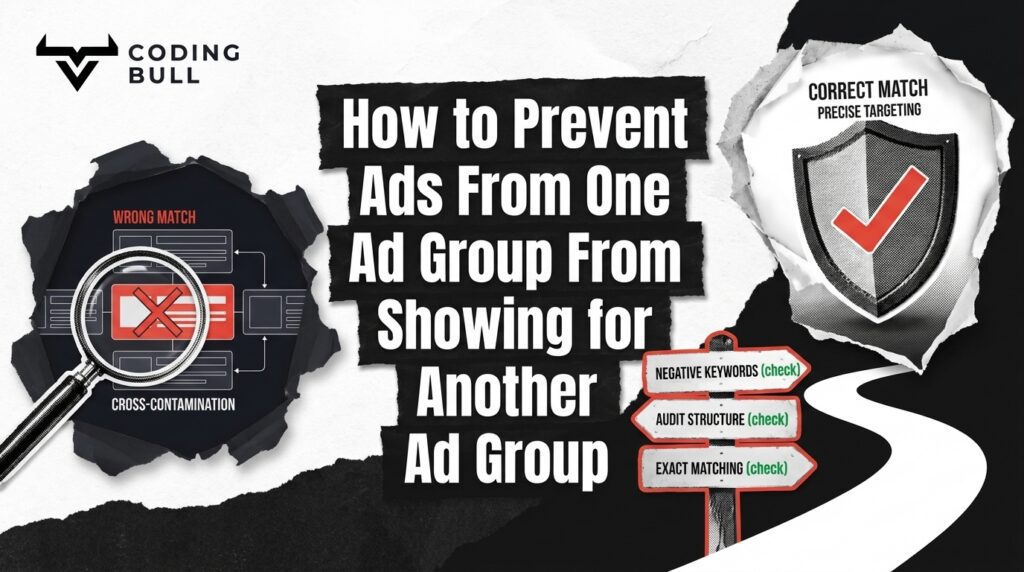
When managing search campaigns, seeing your carefully crafted message trigger for the wrong search query is a frustrating experience. You might be asking yourself, how can I prevent ads from one ad group from showing for another ad group? This cross-contamination happens when search engines match a user’s query to multiple keywords across different ad groups, choosing to display an ad that isn’t perfectly aligned with the user’s specific intent.
We see this issue frequently when auditing underperforming accounts. Addressing this overlap is important because if one ad shows up for another ad group, then the ad relevancy and landing page experience quality score will get dragged down. When relevancy drops, search engines penalize the campaign, reducing ad visibility and severely impacting overall performance. By properly isolating your targeting, you can ensure the right message always reaches the right user.
Understanding Ad Group Cross-Contamination
Cross-contamination occurs when keywords in different ad groups are too similar or rely heavily on broad match types, causing internal competition. Instead of dominating the search results, your ad groups end up competing against one another, confusing the algorithms and diluting your campaign data.
How Overlap Drags Down Ad Relevancy and Quality Score
The core of a successful campaign lies in the user journey. If a user searches for a highly specific service but is served a generic ad from a different ad group, the ad relevancy plummets. This mismatch creates a poor user experience. Consequently, this is important because if one ad shows up for another ad group, then the ad relevancy and landing page experience quality score will get dragged down. A low Quality Score signals to the platform that your ads are not useful, which restricts your reach and diminishes your return on investment.
Analyzing the Search Terms Report for Overlap
To stop this internal competition, we dive deep into the search terms report. This report shows exactly which user queries triggered your ads. By filtering for your core keywords and cross-referencing which ad groups actually delivered the impressions, you can quickly identify where the overlap is occurring.

Structuring Campaigns with Tightly Themed Ad Groups
Proper campaign architecture is the foundation of preventing keyword overlap. We rely on proprietary data-driven frameworks developed over our 11 years in business to build robust account structures. By grouping keywords into tightly themed clusters—often referred to as Single Keyword Ad Groups (SKAGs) or Single Theme Ad Groups (STAGs)—we minimize the chance of cross-triggering from the very beginning.
Over the course of completing 326 projects, our team, led by founder Justin Chan, has utilized deep analytical rigor to structure accounts that scale predictably. Justin brings his extensive background in finance and mathematics to ensure every campaign is built logically. We have partnered with recognizable brands like HUB International, Trimble, Fairmont Pacific Rim, and Evergreen Hospitality Group, applying these same strict architectural standards to ensure their digital presence translates into scalable revenue.
Implementing Ad Group-Level Negative Keywords
The most effective and actionable answer to the question of how can I prevent ads from one ad group from showing for another ad group is the strategic use of ad group-level negative keywords. This technique is often called negative keyword sculpting.
If Ad Group A targets “commercial roofing” and Ad Group B targets “residential roofing,” you must add “residential” as a negative keyword to Ad Group A, and “commercial” to Ad Group B. This forces the search engine to direct the query to the correct ad group every single time. As a recognized National Excellence Award Winner and Top Web Designers Clutch recipient, we know that meticulous negative keyword management is what separates an average campaign from a highly profitable one.

Utilizing Exact Match Types to Control Ad Delivery
Another critical strategy is restricting your keyword match types. Broad and phrase match keywords give search algorithms significant freedom, often leading to ads showing for tangential searches housed in other ad groups. While broad match can be useful for discovery, it is the primary culprit behind ad group cross-contamination.
We frequently leverage exact match types to force the platform to adhere to our strict boundaries. This level of granular control is a major reason why we historically achieve an average 12.5x return on ad spend for our clients across large marketing budgets. By telling the platform exactly what we want—and nothing else—we protect the integrity of each ad group.
- Broad Match: High risk of cross-contamination; requires extensive negative keyword lists.
- Phrase Match: Moderate risk; useful but still requires careful monitoring.
- Exact Match: Lowest risk; provides the tightest control over which ad group enters the auction.
Managing Ad Status in Ads Manager
Sometimes, the issue stems from old, paused, or poorly categorized ads that were never properly deactivated. Regularly reviewing the active status of your ads within your management platform is essential. Ensure that only the most relevant ads are enabled in each specific ad group.

We pride ourselves on being super communicative and accountable. When we manage campaigns, we think like a business owner, meaning we don’t leave outdated ads running unchecked. Keeping a clean account ensures that only your highest-performing assets are live, safeguarding your lead generation efforts.
Conclusion: Maintaining Strict Ad Group Boundaries
Preventing ad overlap is not a one-time setup task; it requires constant improvements and routine audits. You must continually review your search terms, update your negative keyword lists, and refine your match types. Always remember that this is important because if one ad shows up for another ad group, then the ad relevancy and landing page experience quality score will get dragged down.
By applying these data-driven strategies and forward-looking frameworks, we have successfully generated over 230,000 leads and produced $115,000,000 in revenue for our clients. Maintaining strict boundaries between your ad groups ensures that your marketing efforts remain highly targeted, ultimately driving a much stronger return on your investment.